Showing posts with label vocabulary. Show all posts

Thursday, 10 May 2018

Listening - the first step to learning a new language!

Listening is the first and most important step in language acquisition. It is at the very core of learning a new language. When babies first learn their home language, they go through a "Silent Period". Although it may seem that babies are not "doing" anything, they are very busy listening and assimilating the phonetic features of the linguistic environment. 

Similarly, when children learn an additional language, they also go through a "Silent Period". During this time it is essential that they are exposed to the language. Listening to a teacher speaking Afrikaans a couple of lessons a week is not enough for a child to develop a comprehensive understanding. Unfortunately, many children do not have the opportunity to hear Afrikaans in any other setting. Many parents either do not speak Afrikaans or if they do, they do not feel comfortable enough to speak Afrikaans. So what can parents do to help their child learn Afrikaans?

Introducing, Richelle Pretorius' Kinderstories (Children's Stories) YouTube Channel. I was thrilled when I discovered this channel as I have wanted to create a similar channel for years and have just never found the time. Richelle has recorded numerous videos that can be used to help children learn Afrikaans.


At present, Richelle's YouTube Channel consists of three playlists. 

These are videos which cover basic Afrikaans vocabulary. 
These are classic Disney stories read in Afrikaans.
This is a collection of short stories read in Afrikaans. There are no pictures and no English translations. 

I use the Edufriends Afrikaans Reading Course Outline in Grade 3, as my focus is on extending their vocabulary. In Grades 4 and 5, I continue to use this playlist as well as the Ou Gunsteling Boeke in my regular Vocabulary and Reading Assignments posted on Google Classroom.

The Ou Gunsteling Boeke videos, however, are the main reason why I am writing this blog post. The playlist provides additional language learners with the resources needed to just "listen". As I mentioned, the playlist consists of classic Disney stories read in Afrikaans. Many children will most likely have heard these stories in English. As they know the stories they will be able to follow the story and this means that children can just "listen" and begin to assimilate the phonetic features of the Afrikaans language. They have the opportunity to experience that vital "Silent Period".

As children continue to listen to the stories, they should begin to read along which will enhance the learning experience. These stories are also beneficial for children who have a good understanding of the language. Once children have worked through the Ou Gunsteling Boeke videos, they can start listening to Oom Attie se Slaaptydstories.

For parents, Richelle Pretorius' Kinderstories YouTube Channel is a wonderful resource that takes very little effort other than actually finding the time for your child to listen. Now your children have a good reason to watch YouTube Videos. 

Thursday, 7 September 2017

Teaching boys to write their OWN first additional language speeches

I have been teaching Afrikaans as a first additional language since I started teaching almost 20 years ago, first as a class teacher and then as a specialist teacher. One thing that has always worried me is that so many students begin by writing a speech in their first language and then translate it. In my early days as a teacher, this meant students asking their parents or somebody that actually spoke the language to translate it. Nowadays this means pasting the entire speech into Google Translate... which makes for some very amusing and confusing speeches. 

Over the years I have tried various ways to stop this from happening and to get students actually writing their own speeches. The fact of the matter is that if you send a student home with a speech to prepare for homework, you are more than likely going to get one of three outcomes:

1. A speech written or at least translated by someone other than the student. 
2. A speech written using Google Translate.
3. An excuse as to why the speech has not been done. 

It's not that students don't want to write their own speeches, it's that they don't know how. Three years ago I decided explicitly to teach my Grade 4 boys how to write a prepared speech. Each year I have refined the process and each year I am not only thrilled with the quality of the boys' speeches, I am thrilled with the enthusiasm and pride in each boy throughout the whole process. 

I remember way back during my teacher training days listening to a lecture on scaffolding. To those not in education, you may think I am referring to a temporary or movable platform for workers to stand or sit on when working at a height above the floor or even a platform on which a criminal is executed (as by hanging or beheading). However, in education, scaffolding refers to a variety of instructional techniques used to move students progressively toward stronger understanding and, ultimately, greater independence in the learning process. Scaffolding is essential during this process.

The first step is choosing a topic based on the vocabulary the boys have actually been learning or already know. If any new vocabulary is needed this needs to be taught before the speech writing process begins. Parts of the body is a theme that is introduced in the Junior Primary and consolidated in Grades 3 and 4. Instead of asking the boys to write a speech describing their bodies (which is boring for both the boys and I), I give each of the boys their own coloured picture of a monster. Their task is to write a speech to describe their particular monster. 

Some of the monsters.

They should know all the human parts of the body in Afrikaans but just in case they don't I teach the boys how to write the body parts in plural form (which ensures they also know them in singular form too). I have also realised that once they know the plural rules pertaining to the parts of the body, they are able to apply them to other words. I teach them any other monster body parts they may need to know in Afrikaans e.g. horns, tentacles, spots, etc. A good understanding of pronouns is also important when describing their monster. Although the boys have learnt the colours and numbers in Afrikaans, I have found that they tend to forget the basics when they start writing. For this reason, I let the boys use an Afrikaans "Tafelmat" (table mat) that I designed for my Grade 3 boys who are just beginning to write sentences in Afrikaans.

Afrikaans "Tafelmat" (table mat)
  
Afrikaans-English dictionaries are available for the boys to use but I prefer the boys to try and use vocabulary that they already know. I spend a considerable time in Grade 5 ensuring that the boys know how to use an Afrikaans-English dictionary efficiently. 

Once the boys have received the instructions for the speech, together with a picture of a monster they have to talk about, they are allowed to take their monster home and decide on an Afrikaans name for their monster based on what their monster looks like. At this stage I email the parents to explain the whole process to them so that they don't get into a panic and write the whole speech for their son. I always receive wonderful feedback from the parents:

What a great way to do this!! Well done and thank you!!

It sounds wonderful and you have chosen such a fantastic way to approach it.

Sounds awesome. Thanks for sharing. Love the approach.

Thanks, Nicole!!!  Sounds like great fun! Look forward to the end result. :)

Thank you for the time that you take to prepare and approach the subject differently and keep the boys interested.

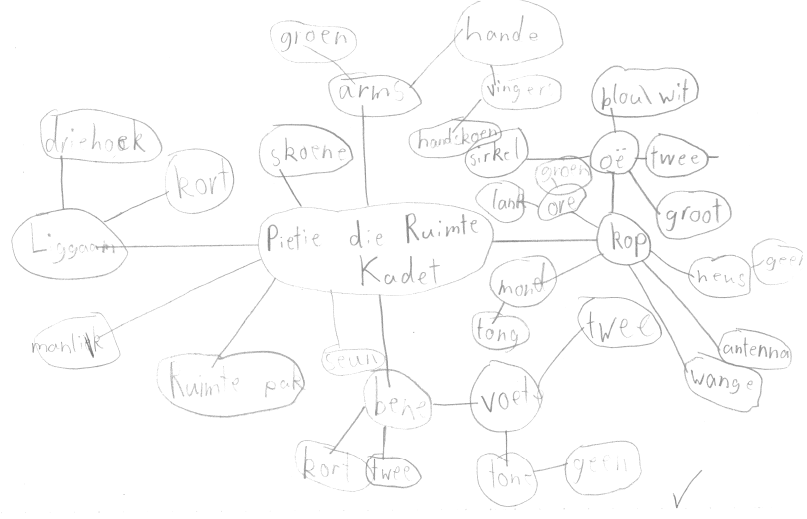
The boys draw their own Bubble Map (one of the eight Thinking Maps) to find the Afrikaans words to describe their monster in as much detail as possible. Although I am available to help them with words it is wonderful to watch them making use of all the resources I have provided for them. I then assess their Bubble Map and then they are ready to start writing their speech.

An example of a Bubble Map
We have all experienced that initial writer's block and for this reason, I get all the boys to start their speeches in the same way:

"My monster se naam is ___________. Hy is manlik / 'n seun. Sy is vroulik / 'n meisie."
(My monster's name is ___________. He is male / a boy. She is female / a girl.)

I then let them get on with the writing. Some of the boys write very short speeches and others go into great detail describing their monsters. The best part is that each boy writes his own speech in Afrikaans and experiences a feeling of achievement. I then assess their writing and make any necessary corrections.

An example of a Speech

The parents are still part of the process as I ask them to help their son finalise his key cards and practise saying the speech. The boys are then ready to present their speeches to the class. Each boy asks a friend to record them while they are saying their speech to the class. While I am finalising my assessment of their speech, they upload the recording to Google Classroom. This recording is then saved to their Classroom folder in Google Drive. They are able to show the recording to their parents and I am able to review their speech if needed.

This quote from an email from a mom of one of the boys I teach sums up that although the whole process is rather time-consuming - it is so worth it.

"When I picked up my son from school yesterday I asked him how his speech went and he said 'it was such fun!' To hear that made my day - doing speeches is daunting enough and to do them in a language other than your first is just scary. I'm so delighted that he enjoyed himself and I really wanted you to know that too." 

Tuesday, 27 June 2017

Quizlet Teacher Ambassador - The New Quizlet Learn

All my boys will tell you that I am passionate about Quizlet so, in February 2017, when I received an invitation to join the "Quizlet's Teacher Ambassador Program" I jumped at the opportunity and excitedly became a "Quizlet Teacher Ambassador".


As a Quizlet Ambassador I receive emails at least once a month with requests to share resources, participate in new feature testing, give feedback, create content for the Quizlet blog and more. One of the new features that I have been introduced to is the New Quizlet Learn. This feature has been developed in order to help students prepare for upcoming tests.

So how does it work? Firstly, this feature is available on the Quizlet app which can be downloaded from the Apple App Store or Google Play. You will not find it on the web based version of Quizlet. All students need to do is open the study set I have assigned them either using the link I post on Google Classroom or directly from their Quizlet Class. They then tell Quizlet when they need to know the material by, and Quizlet Learn will kickstart their studying with an adaptive plan that charts their progress, helps them stay motivated with encouraging checkpoints, and keeps them on track with helpful study reminders. The Old Learn is still available, Quizlet has just renamed it as Write.

Here's a quick video overview of what the New Quizlet Learn is all about.


Wednesday, 24 February 2016

Quizlet

Quizlet is a free website providing learning tools for students, including flashcards, study and game modes. Last year I introduced Quizlet to the boys in all three of the grades I teach in order to help them prepare for spelling tests in a fun and interactive manner. All of the material is user-generated so each time we cover new vocabulary I create a new study set of words for the boys. With six different activities, the boys can study on their own, compete for high scores and test themselves. The website can be accessed from the browser of any device and there are also free mobile apps for iPhone, iPad and Android devices. 


As many studies have shown boys love competition and this website allows the boys to compete against each other. Up until now the boys have been working anonymously. In order for their efforts to be recorded they need to be logged on to the site. When researching the site I was very pleased to see that the designers have a different setting for children under 13. For members under 13, Quizlet has removed access to social sharing features like Facebook and Twitter. Boys can search for classmates, teachers, and friends by Quizlet username in the search box to find their study materials but their real names will never be used on the site. The website provides many pictures that the boys can use for their profile picture but they cannot upload their own image for their profile picture if they are under 13.

I will be signing the boys up over the next couple of weeks. When the boys' accounts are created, as they are all under 13, Quizlet will ask for a parent's email address. Confirmation emails will be sent to the parents' email addresses and parents will need to confirm the accounts. Once the account has been confirmed parents have the option of tailoring their email preferences. Many parents elect to receive all emails as then they receive notifications each time a new set of words is added to their son's account. Each boy’s safety on the net is of utmost importance to us at St Peter’s and many of the websites are catering for this need. All the boys will be signing up through Google as we use Google Apps for Education. I would like all the boys to use the same format when entering their username:

first name     surname initial     grade     class     year

e.g. davidt5JA2016

In this way the boys will be able to identify each other but no one outside of St Peter’s will know who they are. 

The boys will continue to use the site anonymously until their sign up is completed. There is no need for you to register on the site. If you would like to learn more about Quizlet please click on the link below.