Showing posts with label Google Classroom. Show all posts

Thursday, 10 May 2018

Listening - the first step to learning a new language!

Listening is the first and most important step in language acquisition. It is at the very core of learning a new language. When babies first learn their home language, they go through a "Silent Period". Although it may seem that babies are not "doing" anything, they are very busy listening and assimilating the phonetic features of the linguistic environment. 

Similarly, when children learn an additional language, they also go through a "Silent Period". During this time it is essential that they are exposed to the language. Listening to a teacher speaking Afrikaans a couple of lessons a week is not enough for a child to develop a comprehensive understanding. Unfortunately, many children do not have the opportunity to hear Afrikaans in any other setting. Many parents either do not speak Afrikaans or if they do, they do not feel comfortable enough to speak Afrikaans. So what can parents do to help their child learn Afrikaans?

Introducing, Richelle Pretorius' Kinderstories (Children's Stories) YouTube Channel. I was thrilled when I discovered this channel as I have wanted to create a similar channel for years and have just never found the time. Richelle has recorded numerous videos that can be used to help children learn Afrikaans.


At present, Richelle's YouTube Channel consists of three playlists. 

These are videos which cover basic Afrikaans vocabulary. 
These are classic Disney stories read in Afrikaans.
This is a collection of short stories read in Afrikaans. There are no pictures and no English translations. 

I use the Edufriends Afrikaans Reading Course Outline in Grade 3, as my focus is on extending their vocabulary. In Grades 4 and 5, I continue to use this playlist as well as the Ou Gunsteling Boeke in my regular Vocabulary and Reading Assignments posted on Google Classroom.

The Ou Gunsteling Boeke videos, however, are the main reason why I am writing this blog post. The playlist provides additional language learners with the resources needed to just "listen". As I mentioned, the playlist consists of classic Disney stories read in Afrikaans. Many children will most likely have heard these stories in English. As they know the stories they will be able to follow the story and this means that children can just "listen" and begin to assimilate the phonetic features of the Afrikaans language. They have the opportunity to experience that vital "Silent Period".

As children continue to listen to the stories, they should begin to read along which will enhance the learning experience. These stories are also beneficial for children who have a good understanding of the language. Once children have worked through the Ou Gunsteling Boeke videos, they can start listening to Oom Attie se Slaaptydstories.

For parents, Richelle Pretorius' Kinderstories YouTube Channel is a wonderful resource that takes very little effort other than actually finding the time for your child to listen. Now your children have a good reason to watch YouTube Videos. 

Wednesday, 18 October 2017

Parent Tech Talk - 2017


On Wednesday 18 October 2017 I once again hosted a Parent Tech Talk for the parents of the boys I teach in Grade 3, 4 and 5. The talk was well attended and I was impressed to see how many parents were keen to find out what they needed to know about tech in order to support their sons. At the end of the talk I promised to publish my presentation onto my blog for those at the talk as well as those who were unable to attend. Please click on the link below to view the presentation:

Thursday, 7 September 2017

Grade 5 Afrikaans Poems


Creative writing can be stressful for students especially when the writing needs to be in a language other than their first language. This is why it is so important for teachers to scaffold their student's learning. It is essential that we give students the tools to be successful. Another aspect is making their work authentic by giving their work an audience. Each year my Grade 5 boys write Afrikaans poems and this year I decided that Google Classroom, Google Slides and Google Blogger gives me the ability to share these poems with an audience. 

The writing activity involves an initial lesson of reading poems written by other children and explaining the structure of the poems they are going to write. Each poem consists of 4 lines which begin in the same way:

Ek sien (I see)
Ek hoor (I hear)
Ek ruik (I smell)
Ek voel (I feel)

In the next lesson, the boys decide on a topic and write about the topic without mentioning what the topic is. I then mark the three poems and the boys decide which poem is their favourite. 

The final lesson involves Google Classroom. This is the activity I posted on Google Classroom:

You have been writing your own Afrikaans poems in class this week. Now it is time to share them! Once I have marked your three poems, you need to decide which of the three is your favourite poem. You need to learn this poem off by heart in order to present it to the rest of the class. You also need to open the shared document below and find the slide that contains your name. Please type your poem onto this slide. Once everyone has contributed to the document, I will publish it online and share it with your parents, my blog and the world. You are allowed to edit your slide any way you would like (insert pictures or photographs, change the type style, change the background, etc) but please do NOT edit anybody else's slide. I am able to track all the work that is done so I will know who has edited somebody else's slide. Have fun!

Please click on the links below to view the final products:

Ons Eie Gediggies - 5KA

Ons Eie Gediggies - 5MV

Ons Eie Gediggies - 5SO

Teaching boys to write their OWN first additional language speeches

I have been teaching Afrikaans as a first additional language since I started teaching almost 20 years ago, first as a class teacher and then as a specialist teacher. One thing that has always worried me is that so many students begin by writing a speech in their first language and then translate it. In my early days as a teacher, this meant students asking their parents or somebody that actually spoke the language to translate it. Nowadays this means pasting the entire speech into Google Translate... which makes for some very amusing and confusing speeches. 

Over the years I have tried various ways to stop this from happening and to get students actually writing their own speeches. The fact of the matter is that if you send a student home with a speech to prepare for homework, you are more than likely going to get one of three outcomes:

1. A speech written or at least translated by someone other than the student. 
2. A speech written using Google Translate.
3. An excuse as to why the speech has not been done. 

It's not that students don't want to write their own speeches, it's that they don't know how. Three years ago I decided explicitly to teach my Grade 4 boys how to write a prepared speech. Each year I have refined the process and each year I am not only thrilled with the quality of the boys' speeches, I am thrilled with the enthusiasm and pride in each boy throughout the whole process. 

I remember way back during my teacher training days listening to a lecture on scaffolding. To those not in education, you may think I am referring to a temporary or movable platform for workers to stand or sit on when working at a height above the floor or even a platform on which a criminal is executed (as by hanging or beheading). However, in education, scaffolding refers to a variety of instructional techniques used to move students progressively toward stronger understanding and, ultimately, greater independence in the learning process. Scaffolding is essential during this process.

The first step is choosing a topic based on the vocabulary the boys have actually been learning or already know. If any new vocabulary is needed this needs to be taught before the speech writing process begins. Parts of the body is a theme that is introduced in the Junior Primary and consolidated in Grades 3 and 4. Instead of asking the boys to write a speech describing their bodies (which is boring for both the boys and I), I give each of the boys their own coloured picture of a monster. Their task is to write a speech to describe their particular monster. 

Some of the monsters.

They should know all the human parts of the body in Afrikaans but just in case they don't I teach the boys how to write the body parts in plural form (which ensures they also know them in singular form too). I have also realised that once they know the plural rules pertaining to the parts of the body, they are able to apply them to other words. I teach them any other monster body parts they may need to know in Afrikaans e.g. horns, tentacles, spots, etc. A good understanding of pronouns is also important when describing their monster. Although the boys have learnt the colours and numbers in Afrikaans, I have found that they tend to forget the basics when they start writing. For this reason, I let the boys use an Afrikaans "Tafelmat" (table mat) that I designed for my Grade 3 boys who are just beginning to write sentences in Afrikaans.

Afrikaans "Tafelmat" (table mat)
  
Afrikaans-English dictionaries are available for the boys to use but I prefer the boys to try and use vocabulary that they already know. I spend a considerable time in Grade 5 ensuring that the boys know how to use an Afrikaans-English dictionary efficiently. 

Once the boys have received the instructions for the speech, together with a picture of a monster they have to talk about, they are allowed to take their monster home and decide on an Afrikaans name for their monster based on what their monster looks like. At this stage I email the parents to explain the whole process to them so that they don't get into a panic and write the whole speech for their son. I always receive wonderful feedback from the parents:

What a great way to do this!! Well done and thank you!!

It sounds wonderful and you have chosen such a fantastic way to approach it.

Sounds awesome. Thanks for sharing. Love the approach.

Thanks, Nicole!!!  Sounds like great fun! Look forward to the end result. :)

Thank you for the time that you take to prepare and approach the subject differently and keep the boys interested.

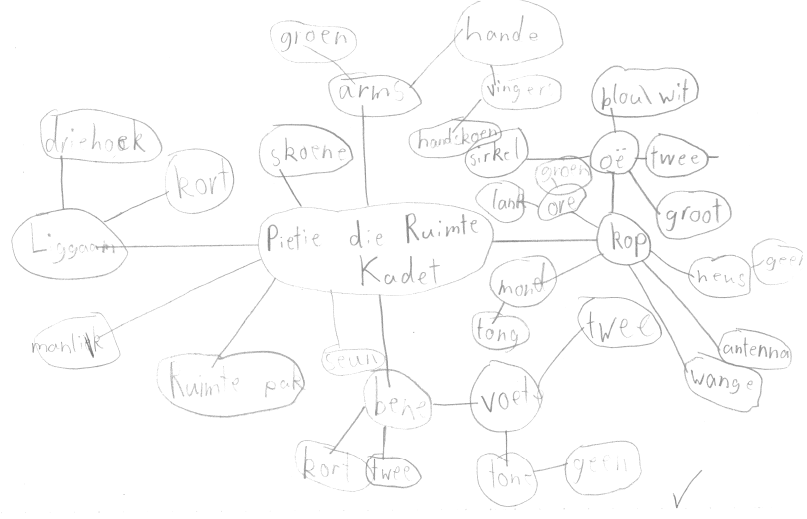
The boys draw their own Bubble Map (one of the eight Thinking Maps) to find the Afrikaans words to describe their monster in as much detail as possible. Although I am available to help them with words it is wonderful to watch them making use of all the resources I have provided for them. I then assess their Bubble Map and then they are ready to start writing their speech.

An example of a Bubble Map
We have all experienced that initial writer's block and for this reason, I get all the boys to start their speeches in the same way:

"My monster se naam is ___________. Hy is manlik / 'n seun. Sy is vroulik / 'n meisie."
(My monster's name is ___________. He is male / a boy. She is female / a girl.)

I then let them get on with the writing. Some of the boys write very short speeches and others go into great detail describing their monsters. The best part is that each boy writes his own speech in Afrikaans and experiences a feeling of achievement. I then assess their writing and make any necessary corrections.

An example of a Speech

The parents are still part of the process as I ask them to help their son finalise his key cards and practise saying the speech. The boys are then ready to present their speeches to the class. Each boy asks a friend to record them while they are saying their speech to the class. While I am finalising my assessment of their speech, they upload the recording to Google Classroom. This recording is then saved to their Classroom folder in Google Drive. They are able to show the recording to their parents and I am able to review their speech if needed.

This quote from an email from a mom of one of the boys I teach sums up that although the whole process is rather time-consuming - it is so worth it.

"When I picked up my son from school yesterday I asked him how his speech went and he said 'it was such fun!' To hear that made my day - doing speeches is daunting enough and to do them in a language other than your first is just scary. I'm so delighted that he enjoyed himself and I really wanted you to know that too." 

Tuesday, 27 June 2017

Quizlet Teacher Ambassador - The New Quizlet Learn

All my boys will tell you that I am passionate about Quizlet so, in February 2017, when I received an invitation to join the "Quizlet's Teacher Ambassador Program" I jumped at the opportunity and excitedly became a "Quizlet Teacher Ambassador".


As a Quizlet Ambassador I receive emails at least once a month with requests to share resources, participate in new feature testing, give feedback, create content for the Quizlet blog and more. One of the new features that I have been introduced to is the New Quizlet Learn. This feature has been developed in order to help students prepare for upcoming tests.

So how does it work? Firstly, this feature is available on the Quizlet app which can be downloaded from the Apple App Store or Google Play. You will not find it on the web based version of Quizlet. All students need to do is open the study set I have assigned them either using the link I post on Google Classroom or directly from their Quizlet Class. They then tell Quizlet when they need to know the material by, and Quizlet Learn will kickstart their studying with an adaptive plan that charts their progress, helps them stay motivated with encouraging checkpoints, and keeps them on track with helpful study reminders. The Old Learn is still available, Quizlet has just renamed it as Write.

Here's a quick video overview of what the New Quizlet Learn is all about.


Sunday, 4 June 2017

Google For Mummies & Daddies


Being a mummy or a daddy to a "Google-literate" school going son can be a little overwhelming at times. No need to fear... "Google For DMummies & Daddies" is here. Well... maybe not a whole book but a blog post at least. 

So what do you need to know about Google as a parent of a Grade 3, 4 or 5 boy in my Afrikaans class? Let me break it down into 3 main points. 

#1

St Peter's is a "G Suite for Education" school which means your son has access to the following:

#2

Each time your son works within Google, irrespective of the device, he needs to sign into his account. He does this by opening the Chrome browser and clicking on "Sign in" which can be found at the top right hand side of the page. He needs to remember to use his St Peter's email address and Login.  
If he is sharing a device, he needs to remove any other accounts each time he signs into Google. This is not necessary if he is using a personal device at home, as he can remain signed in. Once he is signed in all information saved to his Drive as well as all the G Suite for Education Services are accessible. 

#3

I always teach my boys to sign into Classroom as soon as they have signed into Google because that is where I post all the information they need for Afrikaans. It is very easy if they are already signed into Google as the device links the information. All they need to do is open the Classroom app or open a Classroom tab. They then select their Afrikaans classroom. I post announcements, assignments and questions in Classroom. Boys can check when they are writing the next test as well as what will be assessed. They can click directly from Classroom to any site I would like them to visit whether it be Quizlet, Quizizz, Kahoot or a Google Document, File or Folder. The options are infinite. Boys can complete assignments and tests at home if they are absent from school. Classroom also provides the boys the opportunity to comment. This is one of my favourite features as it is a safe introduction to social media. I see all their comments and I am able to reply. I have noticed that often before I have replied another boy in the class has replied. This is a wonderful example of peer support and teaching. 

Tuesday, 25 October 2016

Parent Tech Talk


On Monday 17th October 2016 I hosted a Parent Tech Talk for the parents of the boys I teach in Grade 3, 4 and 5. The talk was well attended and I was impressed to see how many parents were keen to find out what they needed to know about tech in order to support their sons. At the end of the talk I promised to publish my presentation onto my blog for those at the talk as well as those who were unable to attend. Please click on the link below to view the presentation:

Friday, 30 October 2015

Spelling Tests with Google Forms

If you watch young children playing school, the highlight of the game is when marking has to be done. In reality this is not the case. Marking can be an arduous task for any teacher. Most marking requires the skill of a teacher as many questions can be interpreted in a number of ways which means that there can be a number of different but correct answers. Spelling, however, is not one of these tasks. In a spelling test the word is either spelled correctly or incorrectly. I have always maintained that a computer could mark spelling tests... and now they can and they do.  

Introducing Google Forms! I love Google Forms. Since I started using Google Forms in June 2015, I have not had to mark any spelling tests by hand. As I teach all three classes in each of the three grades I teach - that translates to 78 spelling tests that I do not have to mark each time I set a spelling test in a grade. Work smarter not harder, is what I always say!


What does the process involve? Firstly I set out the test in Google Forms. I then customise it with my own header image, font and colours. 


I answer the test on the live form which generates a memo. I enable the "Flubaroo" Add-on which ensures that each submission is marked and an email is sent with the results to the boy's St Peter's email address. Each time a boy answers the test his submissions are recorded on a Responses Spreadsheet. This spreadsheet gives me a breakdown of each boy's answers as well as his overall mark. I can also see the low scoring questions and the average. It is essential that auto-capitalisation, auto-correction, spell check and predictive text is turned off when completing the tests. 


Tuesday, 20 October 2015

Google Classroom


At the beginning of 2015 I joined GEG Dainfern led by Anthony Egbers (@ajegbers) and Pam Macmillan (@Pam_Macmillan). GEG stands for "Google Educator Group" which is a group of teachers who meet on a regular basis to learn, share, inspire and empower each other to meet the needs of their learners through technology. I eagerly await each Saturday workshop which is held every 5 to 6 weeks. We began by learning the basics of using technology for education such as Gmail, Drive and YouTube. Now each time we meet we are introduced to new exciting apps that can be used in the classroom.

It was at the second GEG Dainfern workshop that I was introduced to Google Classroom. Wow! I was blown away by the possibilities this platform opens for teachers. Google Classroom is designed to help teachers create and collect assignments paperlessly. St Peter's is a GAfE School which means that we have registered for free Google Apps for Education and therefore Google Classroom is available to us. 


For the past few months I have been working in Google Classroom with the boys and I have just touched the surface of what can be done using this platform. I am looking forward to sharing what I have already done in Google Classroom as well as what I am planning to do. Here's to the start of an adventure together.