I have been teaching Afrikaans as a first additional language since I started teaching almost 20 years ago, first as a class teacher and then as a specialist teacher. One thing that has always worried me is that so many students begin by writing a speech in their first language and then translate it. In my early days as a teacher, this meant students asking their parents or somebody that actually spoke the language to translate it. Nowadays this means pasting the entire speech into Google Translate... which makes for some very amusing and confusing speeches.
Over the years I have tried various ways to stop this from happening and to get students actually writing their own speeches. The fact of the matter is that if you send a student home with a speech to prepare for homework, you are more than likely going to get one of three outcomes:
1. A speech written or at least translated by someone other than the student.
2. A speech written using Google Translate.
3. An excuse as to why the speech has not been done.
It's not that students don't want to write their own speeches, it's that they don't know how. Three years ago I decided explicitly to teach my Grade 4 boys how to write a prepared speech. Each year I have refined the process and each year I am not only thrilled with the quality of the boys' speeches, I am thrilled with the enthusiasm and pride in each boy throughout the whole process.
I remember way back during my teacher training days listening to a lecture on scaffolding. To those not in education, you may think I am referring to a temporary or movable platform for workers to stand or sit on when working at a height above the floor or even a platform on which a criminal is executed (as by hanging or beheading). However, in education, scaffolding refers to a variety of instructional techniques used to move students progressively toward stronger understanding and, ultimately, greater independence in the learning process. Scaffolding is essential during this process.
The first step is choosing a topic based on the vocabulary the boys have actually been learning or already know. If any new vocabulary is needed this needs to be taught before the speech writing process begins. Parts of the body is a theme that is introduced in the Junior Primary and consolidated in Grades 3 and 4. Instead of asking the boys to write a speech describing their bodies (which is boring for both the boys and I), I give each of the boys their own coloured picture of a monster. Their task is to write a speech to describe their particular monster.
 |
| Some of the monsters. |
They should know all the human parts of the body in Afrikaans but just in case they don't I teach the boys how to write the body parts in plural form (which ensures they also know them in singular form too). I have also realised that once they know the plural rules pertaining to the parts of the body, they are able to apply them to other words. I teach them any other monster body parts they may need to know in Afrikaans e.g. horns, tentacles, spots, etc. A good understanding of pronouns is also important when describing their monster. Although the boys have learnt the colours and numbers in Afrikaans, I have found that they tend to forget the basics when they start writing. For this reason, I let the boys use an Afrikaans "Tafelmat" (table mat) that I designed for my Grade 3 boys who are just beginning to write sentences in Afrikaans.
 |
| Afrikaans "Tafelmat" (table mat) |
Afrikaans-English dictionaries are available for the boys to use but I prefer the boys to try and use vocabulary that they already know. I spend a considerable time in Grade 5 ensuring that the boys know how to use an Afrikaans-English dictionary efficiently.
Once the boys have received the instructions for the speech, together with a picture of a monster they have to talk about, they are allowed to take their monster home and decide on an Afrikaans name for their monster based on what their monster looks like. At this stage I email the parents to explain the whole process to them so that they don't get into a panic and write the whole speech for their son. I always receive wonderful feedback from the parents:
What a great way to do this!! Well done and thank you!!
It sounds wonderful and you have chosen such a fantastic way to approach it.
Sounds awesome. Thanks for sharing. Love the approach.
Thanks, Nicole!!! Sounds like great fun! Look forward to the end result. :)
Thank you for the time that you take to prepare and approach the subject differently and keep the boys interested.
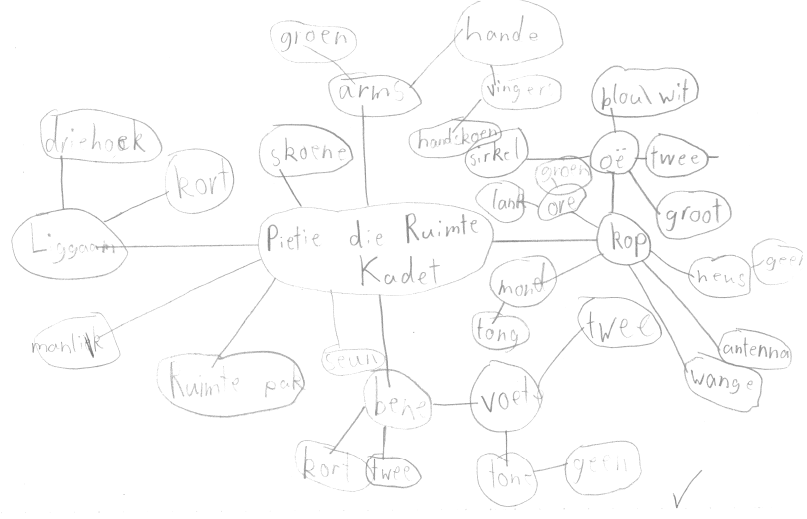
The boys draw their own Bubble Map (one of the eight Thinking Maps) to find the Afrikaans words to describe their monster in as much detail as possible. Although I am available to help them with words it is wonderful to watch them making use of all the resources I have provided for them. I then assess their Bubble Map and then they are ready to start writing their speech.
 |
| An example of a Bubble Map |
We have all experienced that initial writer's block and for this reason, I get all the boys to start their speeches in the same way:
"My monster se naam is ___________. Hy is manlik / 'n seun. Sy is vroulik / 'n meisie."
(My monster's name is ___________. He is male / a boy. She is female / a girl.)
I then let them get on with the writing. Some of the boys write very short speeches and others go into great detail describing their monsters. The best part is that each boy writes his own speech in Afrikaans and experiences a feeling of achievement. I then assess their writing and make any necessary corrections.
 |
| An example of a Speech |
The parents are still part of the process as I ask them to help their son finalise his key cards and practise saying the speech. The boys are then ready to present their speeches to the class. Each boy asks a friend to record them while they are saying their speech to the class. While I am finalising my assessment of their speech, they upload the recording to Google Classroom. This recording is then saved to their Classroom folder in Google Drive. They are able to show the recording to their parents and I am able to review their speech if needed.
This quote from an email from a mom of one of the boys I teach sums up that although the whole process is rather time-consuming - it is so worth it.
"When I picked up my son from school yesterday I asked him how his speech went and he said 'it was such fun!' To hear that made my day - doing speeches is daunting enough and to do them in a language other than your first is just scary. I'm so delighted that he enjoyed himself and I really wanted you to know that too."